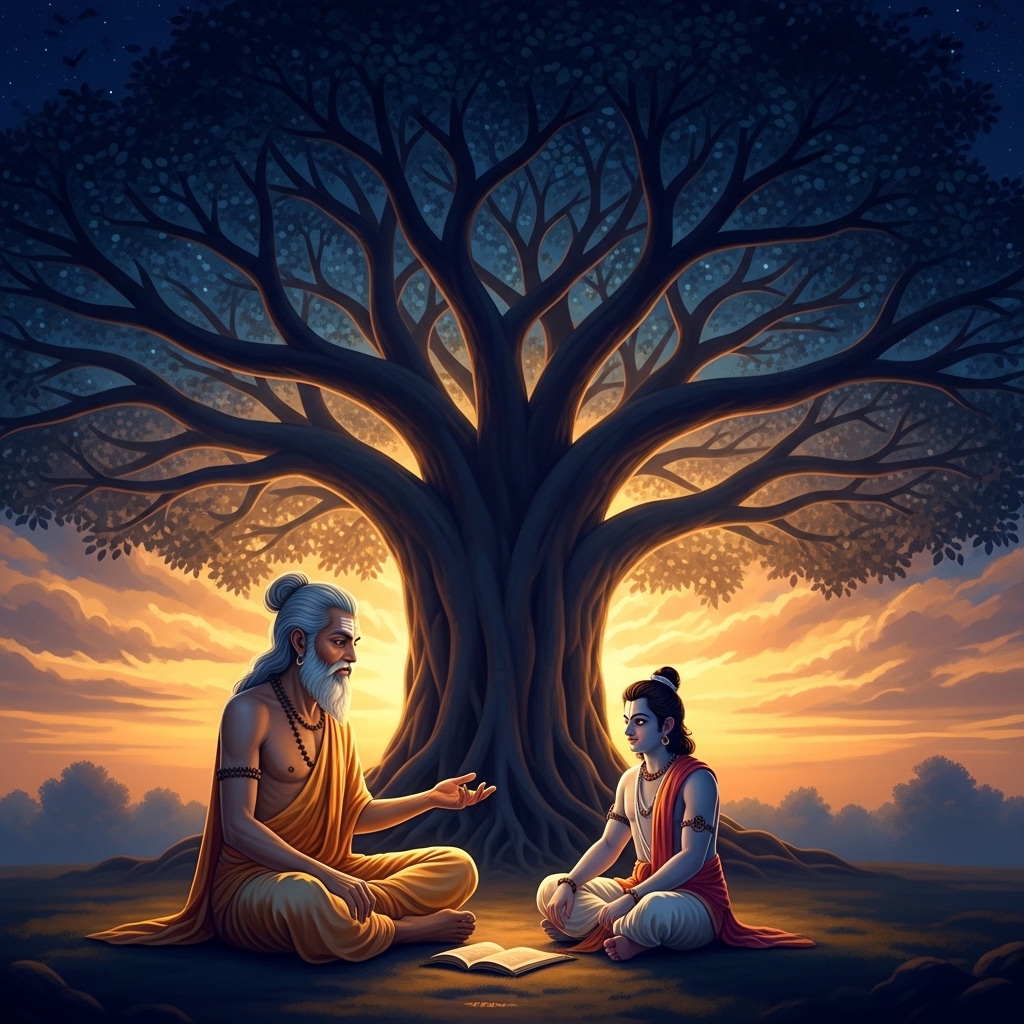
The Yoga Vasistha is among the most ambitious works in the Indian nondual canon. Across thirty-two thousand verses Vasistha instructs the young Rama on the nature of consciousness, the dreamlike quality of the apparent world, and the recognition of one’s true nature as awareness itself.
What distinguishes the text is its method. Where the Upanishads compress and the Brahma Sutras systematise, the Yoga Vasistha unfolds. Long parables sit alongside dense philosophical analysis. Stories of kings, sages, and beings from other worlds are used to dismantle the assumption that any of the apparent world has solidity independent of the consciousness perceiving it.
[ A representative passage. Vasistha’s instruction continues across thirty-two thousand verses in four volumes, weaving philosophy and parable into one of the longest spiritual texts in any tradition. The complete Mitra 1891 translation, roughly 1,400 pages, is at the source linked above. ]
From Book One
The mind is everything. As one thinks, so one becomes. By cultivating elevated thoughts, the mind is purified. By dwelling on what is real and unchanging, the apparent solidity of the world dissolves of its own accord.