Christian Mysticism
A continuous lineage of contemplatives within the Christian tradition who pointed past doctrine and image to a direct encounter with the ground of being.
We awaken in Christ's body as Christ awakens our bodies, and my poor hand is Christ. He enters my foot, and is infinitely me.
Christian Mysticism is the contemplative spine of the Christian tradition. It is not a separate religion or sect. It is the strand within Christianity that has always pointed past doctrine, past liturgy, past image, to the direct encounter with what the tradition variously calls God, the ground of the soul, the Cloud of Unknowing, the divine darkness, the inner light.
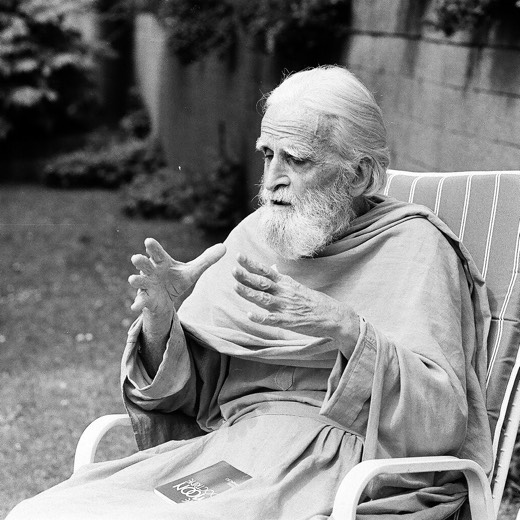
The lineage runs from Augustine (Confessions) in the fourth century, through the Byzantine East where Symeon the New Theologian insisted that the divine light is to be seen in this life and not believed in at second hand, through Bernard of Clairvaux (Sermons on the Song of Songs) and the Cistercians, through the Rhineland masters Meister Eckhart (Sermons), Tauler (Sermons), and the anonymous author of the Theologia Germanica, through the English contemplatives Julian of Norwich (Revelations of Divine Love) and the Cloud of Unknowing, into the Spanish Golden Age with John of the Cross (Dark Night of the Soul) and Teresa of Avila (Interior Castle), on through Brother Lawrence (The Practice of the Presence of God) and the French school, and into the modern era with figures like Bede Griffiths and Anthony de Mello who carried the contemplative current into dialogue with Eastern nondual traditions.
Across nine centuries the lineage holds one conviction: the encounter with the divine is lived, not merely believed. The mystics use Christian language because that is the soil they grew in, but the experience they describe of self emptying, of unknowing, of the soul finding its ground beyond all images, repeats across traditions that never read one another. Read alongside the Advaita masters or the Sufis or the Buddhists of the Middle Way, the kinship is hard to miss.
The Christian mystics have a particular gift for the language of love and union. Where Advaita says not two, the mystics say the soul and God are one. Where the Buddhists describe emptiness, John of the Cross writes of the dark night in which all attachments fall away. Only the vocabulary changes.
A talk from the lineage
The library

Confessions
Confessiones
The first sustained spiritual autobiography in Western literature. Augustine writes the Confessions as a long prayer addressed directly to God, tracing the movement of his soul from dispersion in worldly desire to the recognition that God is interior to the soul itself.
Read text
Sermons on the Song of Songs
Sermones super Cantica Canticorum
Bernard's eighty-six sermons on the biblical Song of Songs are the most influential treatment of bridal mysticism in the Christian tradition. Written and revised across the last two decades of his life, they trace the soul's stages of love from the kiss of the feet through the kiss of the hands to the kiss of the mouth.
Read text
Sermons and Tracts
Predigten und Traktate
The German sermons of Meister Eckhart push Christian apophatic theology into formulations of strikingly nondual recognition. Preached to lay audiences and Beguine communities of the Rhineland in the early fourteenth century, they remain the most radical sustained body of mystical writing in Western Christianity.
Read text
Theologia Germanica
Eyn deutsch Theologia
An anonymous Rhineland tract, almost certainly written within the circle of Tauler and the Friends of God in the late fourteenth century. The text crystallises the apophatic mysticism of the Rhineland tradition into a compact handbook on the soul's emptying into the divine ground.
Read text
Sermons
Tauler's vernacular German sermons carry Eckhart's nondual mysticism into pastoral form, accessible to lay Christians and shaped by the experience of preaching to communities living through the Black Death of 1348-50.
Read text
Revelations of Divine Love
Julian's record of the sixteen visions she received during a near-fatal illness at the age of thirty, with her sustained twenty-year meditation on what they meant. The first known book in the English language written by a woman, and one of the most beloved works of contemplative literature.
Read text
The Cloud of Unknowing
An anonymous spiritual director writes to a young contemplative disciple, mapping a path of prayer that requires the deliberate setting aside of all thoughts, images, and concepts of God. The Cloud is the most concentrated apophatic manual in the Christian English tradition.
Read text
The Dark Night of the Soul
La noche oscura del alma
John of the Cross's prose commentary on his own short poem describing the soul's nighttime journey toward union with God. The Dark Night is the most precise account in any tradition of the systematic dismantling of every spiritual support that the soul might still cling to.
Read text
The Interior Castle
El castillo interior, o las moradas
Teresa of Avila's mature masterpiece, written in five months at the age of sixty-two under direct order from her superiors. The Interior Castle maps the soul as a crystal castle of seven mansions, with God dwelling in the innermost room and the contemplative path as the slow journey inward.
Read text
The Practice of the Presence of God
A small book of recollected conversations and letters compiled after the death of Brother Lawrence in 1691. The Practice of the Presence of God reduces the contemplative life to one continuous practice, the moment-by-moment turning of the heart toward God in the midst of ordinary work.
Read text
The Imitation of Christ
De Imitatione Christi
Thomas à Kempis's four-book manual on the inward turn, the most-read Christian devotional text after the Bible. Composed in the Devotio Moderna communities of the Low Countries, it teaches a contemplative life rooted in self-knowledge and the imitation of Christ's poverty of spirit.
Read text
The Spiritual Exercises
Exercitia spiritualia
Ignatius's four-week retreat manual, the spine of the Jesuit contemplative tradition. The Exercises are not a book to read but a structured month of meditations on creation, sin, the life of Christ, the Passion, and the Resurrection, designed to bring the retreatant to discernment between the consolations and desolations of the spirit.
Read textThe voices