Modern Nonduality
A loose lineage of late twentieth and early twenty-first century teachers, drawing variously on Advaita Vedanta, Zen, the Direct Path, and Christian mysticism, who have brought the recognition of nondual awareness into ordinary contemporary English.
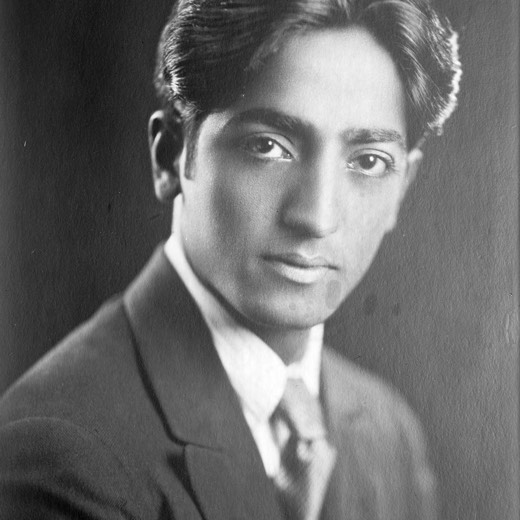
I maintain that truth is a pathless land, and you cannot approach it by any path whatsoever, by any religion, by any sect.
Modern Nonduality is less a tradition than a confluence. Over the second half of the twentieth century, three older streams emptied into the same delta. The Advaita lineage flowed west through Ramana Maharshi’s direct disciples and through Nisargadatta Maharaj and Ramesh Balsekar in Bombay. Zen flowed west through Suzuki, the San Francisco sangha, and the post-1960s American teachers. The Christian contemplative current, dormant outside the monasteries for centuries, surfaced again in the writings of Bede Griffiths, Anthony de Mello, and a small number of lay mystics. By the 1990s these streams were no longer separate. The vocabulary that emerged, awareness, presence, recognition, the absence of a separate self, is recognisably the old teaching in plain English.
The teachers gathered here are a representative cross-section. Two (Papaji and Robert Adams) were direct disciples of Ramana Maharshi. Two (Sailor Bob Adamson and Wayne Liquorman) carry the Nisargadatta and Ramesh Balsekar transmission. Greg Goode teaches the Direct Path of Atmananda Krishna Menon as filtered through Jean Klein, alongside Buddhist Madhyamaka. Gangaji is a Papaji student who has held Western retreats since the early 1990s. Adyashanti arrives by way of a Zen training. John Butler, the outlier, is an English Christian contemplative whose decades of solitary prayer are heard, by readers of Eckhart and the Cloud author, as a continuation of the same lineage.
They share no doctrine and no method, only the pointing itself. There is no separate self. Awareness is not a thing the person has, the person is a movement of thought arising in awareness. The recognition is sudden, available now, and unrelated to one’s history. The teachers differ on whether to call this enlightenment or to refuse the word, on whether to offer practices or to refuse practices, on whether to keep the original Sanskrit and Pali and Greek vocabulary or to set it down and speak only in English. The pointing is the same.
The library

The voices