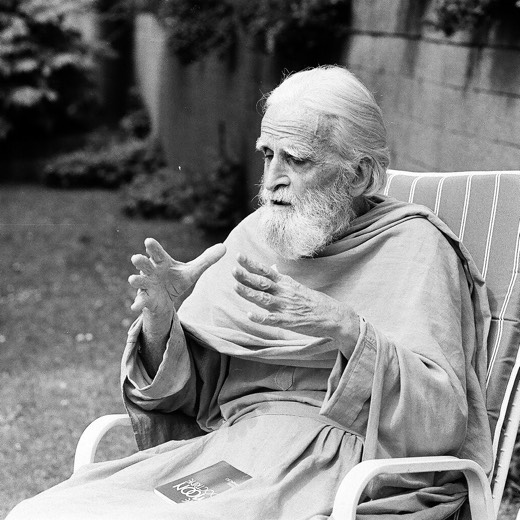
Bernard was the most influential Christian voice of the twelfth century. As abbot of Clairvaux he reshaped the Cistercian order, preached the disastrous Second Crusade, served as advisor to popes and kings, and across all of it kept up a steady output of contemplative writing that made him the central spiritual teacher of his age.
His most enduring work is the eighty-six Sermons on the Song of Songs. The biblical Song is a frank love poem between two human lovers; Bernard reads it as a map of the soul’s progressive intimacy with the divine. The kiss of the mouth, the embrace, the search for the beloved through the night streets, all become stages of contemplative experience. Bernard’s reading was not original but his depth and patience made it the canonical treatment for the next four centuries.
Bernard’s mysticism is affective. Where Augustine emphasised intellectual ascent and Eckhart would later emphasise apophatic stripping, Bernard placed love at the centre. The soul does not arrive at union by knowing more or stripping further but by loving more completely. His treatise On Loving God lays out four degrees of love, ending in a love so pure that the self is forgotten in the beloved.
He died at Clairvaux in 1153 and was canonised twenty-one years later. His influence on every subsequent Western mystic, from the Rhineland masters to Teresa of Avila to the modern Trappists, is direct. Dante gave him the final role in the Divine Comedy: it is Bernard who guides the pilgrim through the last stage of the vision of God.
The teaching
On Loving God lays out four degrees through which love matures. In the first, a person loves themselves for their own sake. In the second, they love God, but for what God gives them. In the third, gratitude has deepened into delight, and they love God for God’s own sake. The fourth degree is loving even oneself only for God’s sake. The self is no longer the centre from which love proceeds; it has become one of the things loved in God. Bernard compares this state to a drop of water in wine or iron in fire, which keeps its nature while taking on the form of what holds it, and he doubted the fourth degree could be sustained for more than moments in this life.
Nothing in the map is forced. Each degree grows out of the one before it as the soul discovers, by experience rather than instruction, that what it was seeking in itself was always God. Bernard’s claim is that desire, followed honestly all the way down, ends in self-forgetting.
Where to start
- Sermons on the Song of Songs: hosted here in the Eales translation; the first three sermons, on the kiss, show the whole method.
- On Loving God: the four degrees of love, short and complete, at the Christian Classics Ethereal Library.
- Bernard at CCEL: the wider catalogue of his works in English translation.