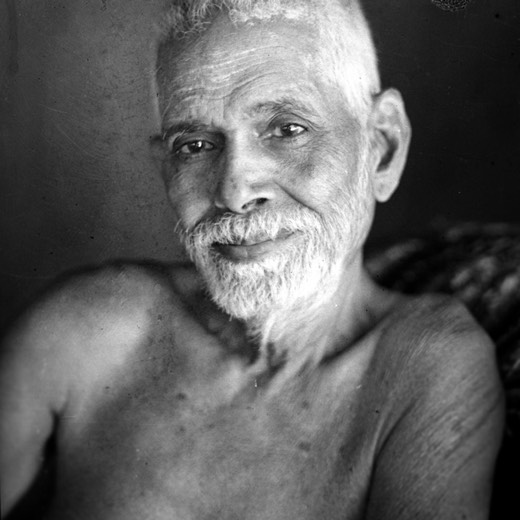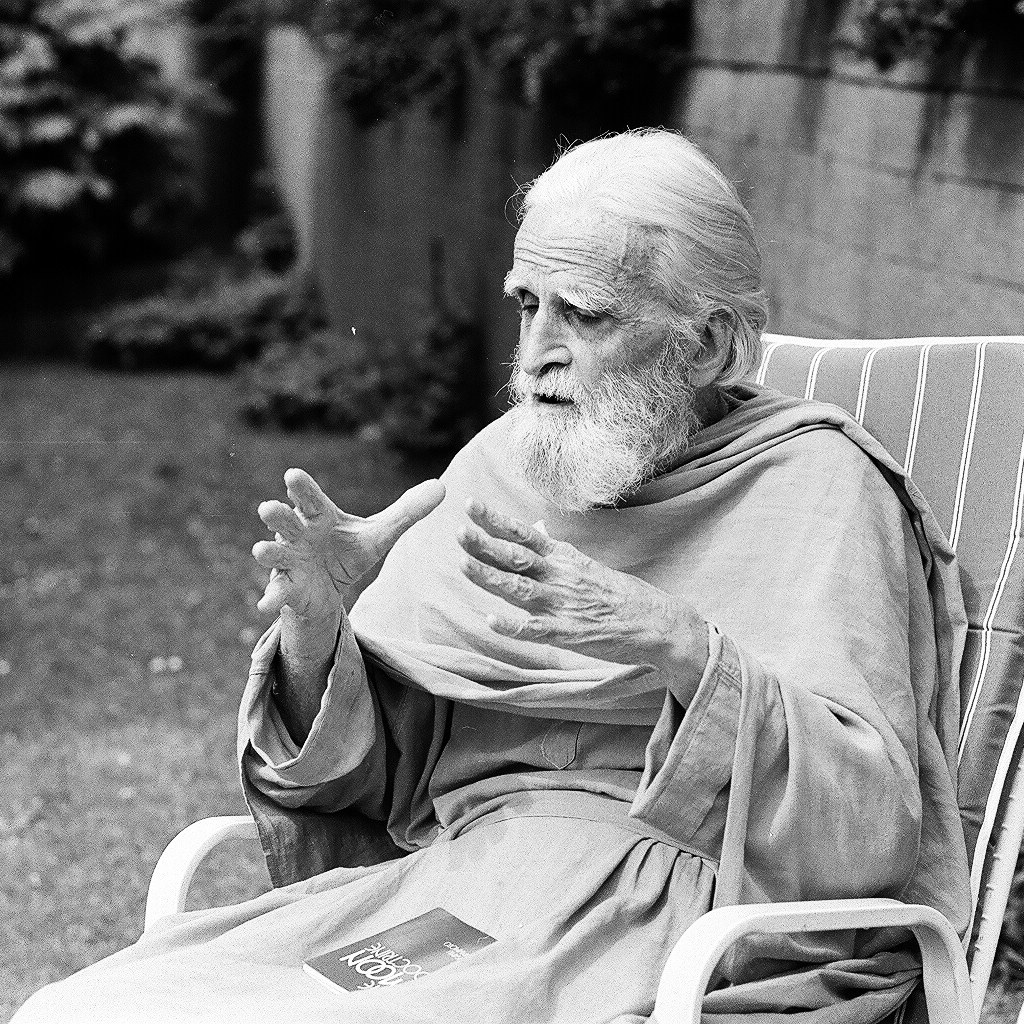
Alan Richard Griffiths grew up in England, read literature at Oxford under C.S. Lewis, became a Roman Catholic and then a Benedictine monk, taking the name Bede. By his forties he had begun to feel that the European Christian tradition he had inherited was, as he put it, working only with the conscious mind. Something else, something his own tradition had partly lost, was alive in the East.
In 1955 he went to India, intending to stay for a year. He stayed for thirty-eight. He eventually settled at Shantivanam, a small Christian ashram on the Cauvery river in Tamil Nadu founded by the French Benedictines Jules Monchanin and Henri Le Saux. He took the Indian name Swami Dayananda, wore the saffron robe of a sannyasi, lived in a thatched hut, and guided the ashram community from 1968 until his death in 1993.
His project was integrative: to live the Christian contemplative life within an Indian ashram framework, to read the Christian scriptures alongside the Upanishads and the Bhagavad Gita, and to take seriously the possibility that the nondual recognition described by Advaita and the personal communion described by Christianity were two languages for one underlying truth. His major books, The Marriage of East and West (1982) and A New Vision of Reality (1989), develop this framework.
In 1990 a severe stroke nearly killed him. He described the weeks that followed as a breaking open, an experience of overwhelming love that softened what remained of the English intellectual in him, and he spent his last three years teaching and travelling with a new simplicity. He died at Shantivanam in May 1993.
The teaching
Shantivanam under Bede was the teaching made visible. The ashram kept the full shape of Benedictine life, prayer at fixed hours, study, manual work, hospitality, and set it inside Indian forms. Prayer opened with Sanskrit chant. Readings came from the Upanishads and the Gita alongside the Psalms and the Gospels. The Eucharist was celebrated with Indian gestures of offering: flowers, incense, the waving of lights.
Behind the forms sat a precise conviction. Bede held that every religion points to a mystery beyond its own concepts, and that the traditions therefore meet at contemplative depth, in what the Upanishads call the cave of the heart. He argued that the Western church had developed the rational and organisational sides of its inheritance while letting the intuitive and contemplative side wither, and that India had kept that side alive. The two halves of the world, like the two halves of the human mind, needed each other. The Marriage of East and West works this out in full, tradition by tradition, and remains the best single statement of his position.
Where to start
His writings are under copyright, so we link out rather than hosting them.
- The Golden String: his autobiography up to his monastic vows, borrowable at the Internet Archive.
- The Marriage of East and West: the central statement of his project, borrowable at the Internet Archive.
- The Bede Griffiths Sangha: recordings, a guide to his books, and news of the communities continuing his work.