They who live without Love are dead. But the worst of all deaths is this — that the loving soul be cowardly toward Love.
What happens to me, whether I am wandering in the country or put in prison — however it turns out, it is the work of Love.
A thirteenth-century Flemish woman wrote those lines. Her name was Hadewijch. We know almost nothing else about her.
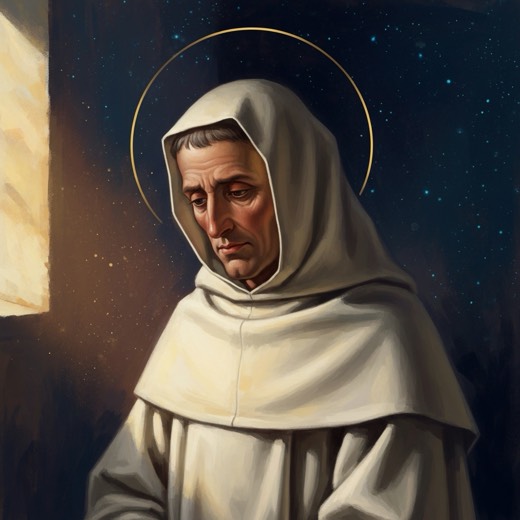
We do not know when she was born or when she died. We do not know where she is buried. No portrait of her exists, no biography, no contemporary account of her life. What we have are her writings, and a few sentences inside those writings that hint at what happened to her. She was probably a Beguine, part of an irregular movement of women in the Low Countries who lived together in prayer and works of mercy without taking formal vows, without entering an order, and without submitting to a male religious authority. She was educated, fluent in Latin and French, and almost certainly came from a noble family. For a time she seems to have been the spiritual head of her community. Then, somewhere along the way, she was expelled from it, and possibly imprisoned. After that she vanishes from the historical record entirely.
What survives are her letters of spiritual counsel, a series of recorded visions, and a body of love poetry written in Middle Dutch that drags the reader straight into the mystical life rather than describing it from outside.
Love, by every name
Hadewijch’s central word is Minne. The usual translation is Love, but the English word is too small for what she means. Minne is the love that is God, the love with which God is loved, and the love by which the soul is drawn out of itself and consumed. It is at once a person, a force, a Lady, a fire, an abyss, and a wilderness. In one of her most famous poems, Love Has Seven Names, she names Minne as Bond, Light, Coal, Fire, Dew, Living Water, and Hell.
She did not choose that last name lightly. For Hadewijch, the experience of divine love includes everything love can do to a human being. It elevates and it wounds. It floods the soul with sweetness, then withdraws and leaves the soul in the dark. She refuses to soften any of this for the reader.
Although the season is joyful everywhere, and mountain and valley are all verdant, that would seem a truly small matter to him who has met mischance in love.
The abyss
The image that runs through Hadewijch’s writing more than any other is the abyss. Soul, God, and Love are each, in her vocabulary, an abyss, and their meeting is an endless falling of one bottomlessness into another.
The soul is a bottomless abyss in which God suffices to himself; and his own self-sufficiency ever finds fruition to the full in this soul, as the soul, for its part, ever does in him.
She is reaching for something the rational mind cannot hold. The deeper she goes into the experience of union, the less there is to describe. Her later poems begin to use a language of nakedness, void, and pure unknowing, of stripping away every image, every form, every name, until what remains is what she calls a wild desert of the divine essence. She anticipates here the apophatic theology that Meister Eckhart would develop a generation later. Eckhart almost certainly read her, or read those who had read her.
Hadewijch is a Christian mystic, working inside the framework of a personal, Trinitarian God. At the deepest reaches of her experience, she keeps describing something that is no longer two.
The loved one and the Beloved dwell one in the other, and they penetrate each other in such a way that neither of the two distinguishes himself from the other. They abide in one another in fruition, mouth in mouth, heart in heart, body in body, and soul in soul, while one sweet divine nature flows through them both, and they are both one thing through each other, but at the same time remain two different selves — yes, and remain so forever.
That last clause is what makes her writing so peculiar and so precise. One thing through each other, and yet two. She refuses to resolve the paradox in either direction.
Noble unfaith
One of her most original and unsettling teachings is what she calls noble unfaith.
The soul that truly loves God, for Hadewijch, eventually reaches a point where it can no longer rest in the consolation of believing it is loved back. Faith in the conventional sense, the comfortable certainty that God is near, that the soul is held, that love is mutual, becomes a resting place that Minne will not allow. The soul that loves Love itself has to let go even of the assurance of being loved.
Unfaith never allows desire any rest in any fidelity but, in the fear of not being loved enough, continually distrusts desire.
On the surface this sounds like spiritual torment. For Hadewijch it works the other way around. Unfaith enlarges the soul. It refuses every small consolation, every comfortable belief, every premature settlement, and so keeps the soul open and hungry and burning. It will not let love become a possession.
In a tradition that often equates faith with security, this is almost shocking. The deepest love does not seek security. It seeks the Beloved, and is willing to let go of every guarantee along the way.
The fierce critic
Read Hadewijch for a while and you start to notice she is much more than a love poet. She is a spiritual director with a sharp, almost biting intelligence, and she has very little patience for what we would now call spiritual bypassing.
Nowadays this is the way everyone loves himself; people wish to live with God in consolations and repose, in wealth and power, and to share the fruition of his glory. We all indeed wish to be God with God, but God knows there are few of us who want to live as men with his Humanity, or want to carry his cross with him.
She saw the desire to skip past suffering, past the body, past the ordinary work of being human, and arrive directly at the glory, and she refused it. Real love of God, for Hadewijch, includes living the human life all the way through.
She also writes, with great clarity, about the danger of doing spiritual work for any kind of reward.
Do good under all circumstances, but with no care for any profit, or any blessedness, or any damnation, or any salvation, or any martyrdom; but all you do or omit should be for the honor of Love.
There is no earning, no banking, no accumulation in her account of the spiritual life. There is Love, and what Love asks of you.
What she leaves us
Hadewijch was lost for centuries. Her manuscripts were rediscovered in the Royal Library in Brussels in the nineteenth century, and only really began to be translated and read in the twentieth. She is still less well known than Eckhart, less famous than Teresa of Avila, less quoted than John of the Cross, though she belongs in their company and arguably stands above them.
Her voice takes the language of courtly love poetry, of knights and ladies and impossible longing, and turns it into theology, holding intimacy and abyss, sweetness and storm, in the same line.
Her last recorded words, in the closing of a letter, are these:
Farewell and live a beautiful life.
She knew what she was asking for, and what it would cost.
Reading her
There is no public-domain English translation. The standard scholarly version is the Paulist Press Classics of Western Spirituality volume translated by Mother Columba Hart (1980), which gathers the Letters, Visions, and Poems in Couplets. Selections also appear in Bernard McGinn’s The Flowering of Mysticism and in anthologies of Beguine writing.