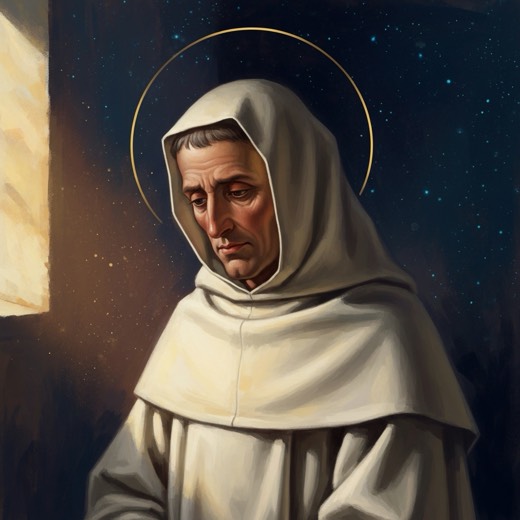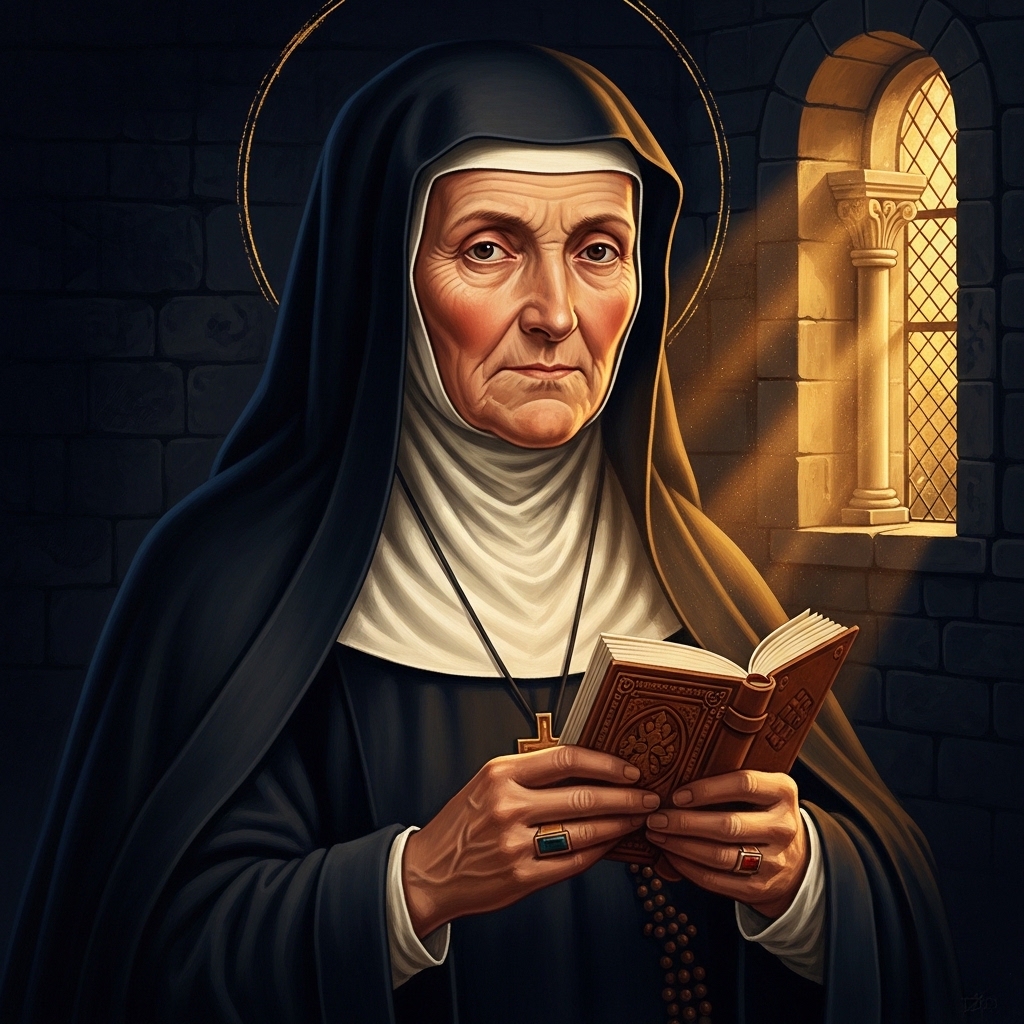
Hildegard of Bingen had a range no one else in the medieval West matched. A Benedictine nun who founded her own monastery on the Rupertsberg above the Rhine, she experienced visions from early childhood, finally accepting in her forties the call to write them down. The result, her Scivias, is a record of twenty-six visionary experiences accompanied by extended theological and cosmological commentary.
She was also a composer of liturgical music whose surviving compositions are now widely performed, a natural philosopher whose works on medicine and the properties of plants and stones still circulate, a poet, a playwright, and the author of a constructed language. She corresponded with popes, kings, abbots, and the leading scholars of her age, who wrote to her seeking counsel, and in her sixties and seventies she travelled the Rhineland on preaching tours, unheard of for a woman of her century.
Her central image is the living light, a divine luminosity that she claimed to perceive directly, waking, with her ordinary faculties intact, and to which all her teaching pointed. Her cosmology is integrative: human beings, the natural world, and the divine are woven together in a single living order. Hildegard was canonised and named a Doctor of the Church in 2012, more than eight centuries after her death.
The teaching
Viriditas is Hildegard’s signature idea. The word is Latin for greenness, and earlier writers had used it conventionally; Hildegard made it the centre of a whole theology. Viriditas is the moist, green, fertile energy by which God animates the world. It is what makes a plant grow, a wound heal, a soul flourish. Its opposite in her vocabulary is ariditas, dryness, the withering that sets in wherever a creature cuts itself off from its source. Sin, in her account, behaves less like crime than like drought.
The idea joins everything she did. Her visions present the cosmos as a single living body kept fruitful by the divine life moving through it. Her medicine treats the body’s health as viriditas in balance and illness as its depletion. Her music, with its long arcing melodic lines, was written so that singing itself would restore the soul’s greenness. For readers coming from the nondual traditions, viriditas is the natural point of contact: the divine met directly as the aliveness of everything alive.
Where to start
There is no public-domain English translation of her major works, so we link out rather than hosting text bodies.
- Scivias: the Hart and Bishop translation in the Classics of Western Spirituality series, borrowable at the Internet Archive.
- International Society of Hildegard von Bingen Studies: translations, scholarship, and a guide to her music and letters.
- Hildegard at Wikipedia: a thorough overview of her life, works, and the long road to her canonisation.