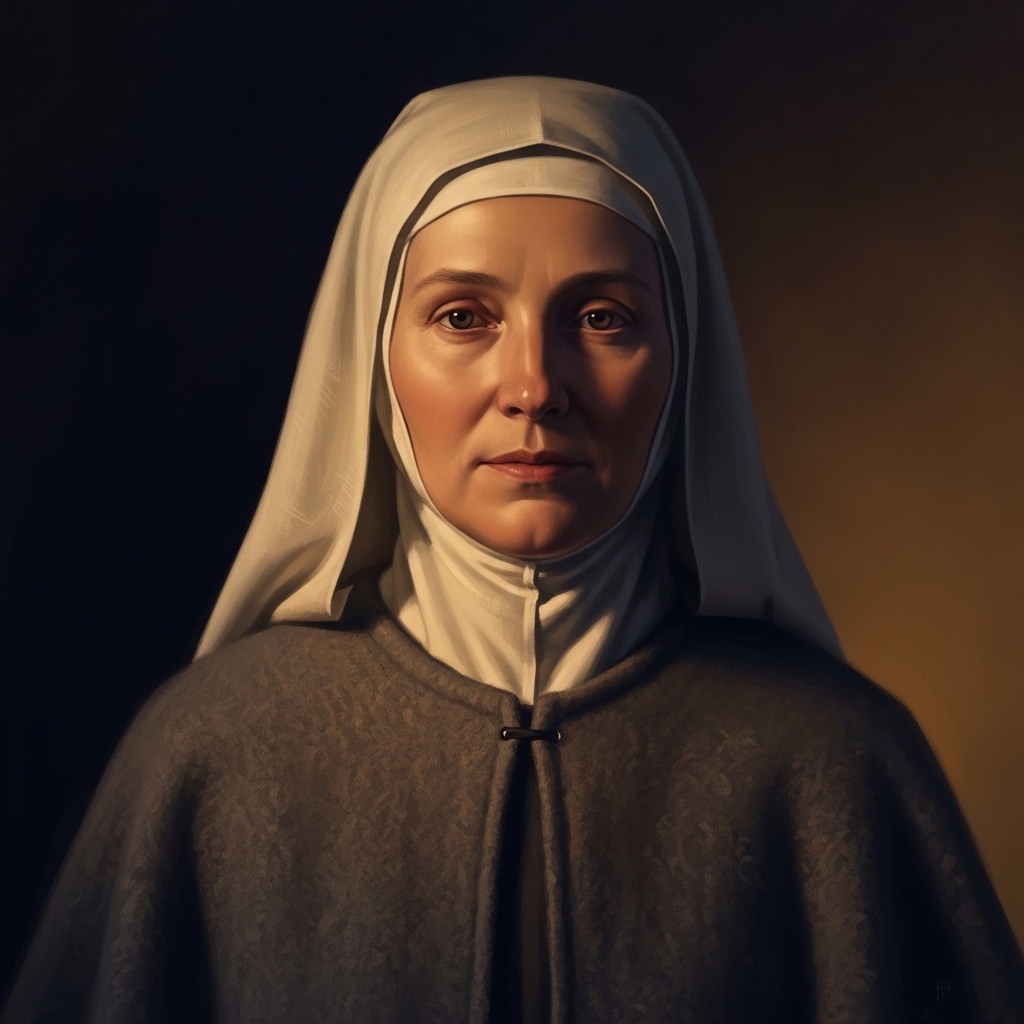
Mechthild was a Beguine, a member of the lay women’s spiritual movement that spread across the Low Countries and Germany in the thirteenth century. The Beguines lived in voluntary community, took no permanent vows, supported themselves by manual work, and pursued contemplation outside the formal structures of the established religious orders. Their movement was eventually suppressed.
Mechthild began having mystical experiences in her early teens. At her confessor’s urging she started recording them around 1250 and continued for the next thirty years. The result is The Flowing Light of the Godhead (Das fließende Licht der Gottheit), a sequence of visions, dialogues, prose poems, and theological reflections written in Middle Low German. It is the earliest substantial mystical work in any German vernacular and prefigures by half a century the work of Eckhart and Tauler.
Her mysticism is bridal and erotic in the medieval sense: the soul as bride, God as bridegroom, their union as a love affair conducted in courtly imagery. She is also bold. She speaks back to God, complains, demands, plays. She criticised the corruption of the clergy of her time so directly that her position became unsafe, and she spent her last years in the shelter of the convent of Helfta, then the leading centre of women’s mystical writing in Germany.
The teaching
The book’s title is its teaching. God, for Mechthild, is light that flows. The divine does not sit at the summit of a hierarchy waiting to be climbed toward; it pours itself out continuously, and the soul is what receives the pouring. Her images are liquid throughout: God as a spring, grace as a flood, the Godhead as an ocean the soul flows back into. The flowing runs in both directions. The soul’s desire streams up toward its source, and union is the meeting of the two currents.
This gives her mysticism an unusual emotional honesty. Because union is a living exchange rather than a fixed achievement, it has weather. Distance, longing, and God’s apparent absence appear in the book as movements within the love affair, and some of its strongest passages concern estrangement, the times the bride waits and the bridegroom does not come. Mechthild treats these as part of how love deepens, an account that anticipates John of the Cross’s dark night by three centuries. Her willingness to record the waiting alongside the rapture is part of why the book still reads as a report rather than a performance.
Where to start
There is no public-domain English translation, so we do not host the text here.
- The Flowing Light of the Godhead: Frank Tobin’s 1998 translation, the standard modern edition, borrowable at the Internet Archive.
- The Revelations of Mechthild of Magdeburg: Lucy Menzies’ 1953 translation, older and more devotional in tone, also borrowable.
- Mechthild at Wikipedia: a solid overview of her life and the textual history of the book.