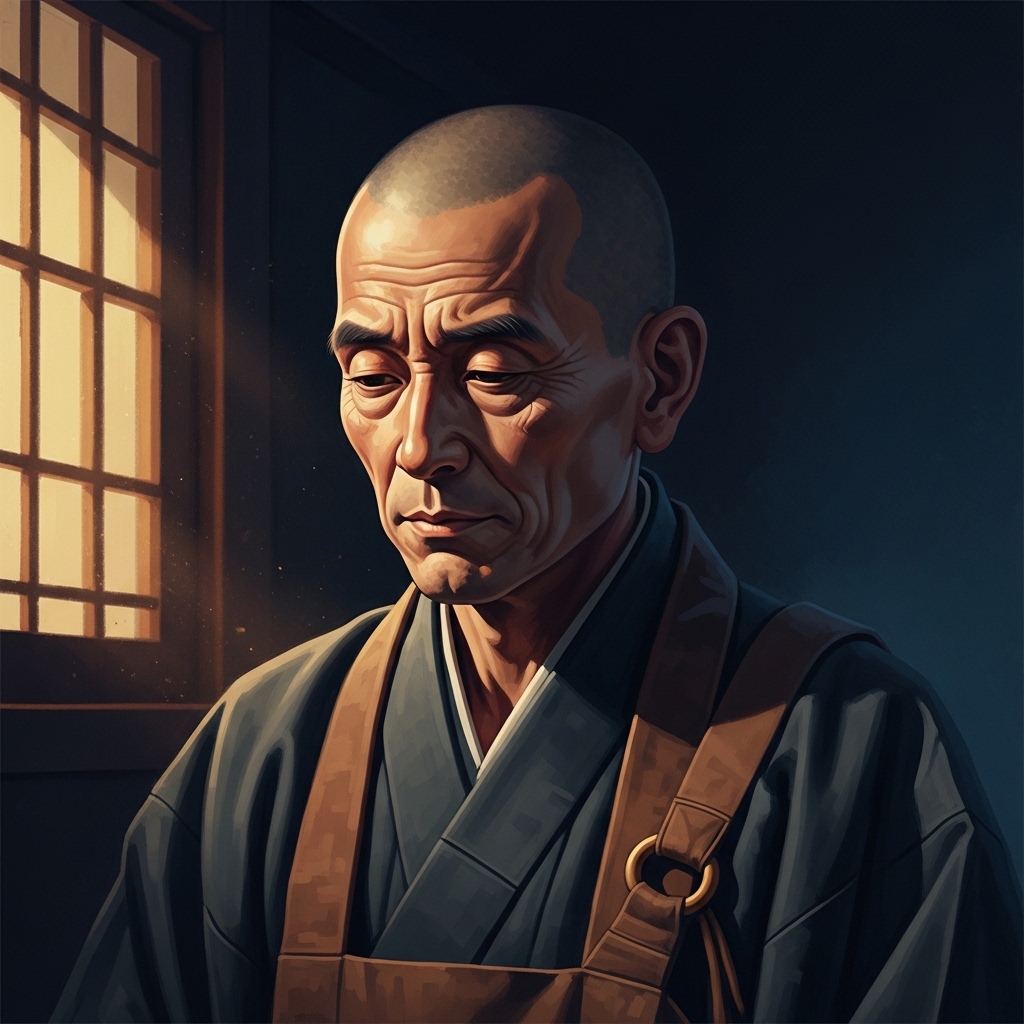
Bankei Yōtaku was born in 1622 in a village near Himeji on Japan’s Inland Sea, the son of a samurai-turned-physician. He was, by every account, a difficult and brilliant child. The Confucian texts he was given to study began to oppress him with the question, what is bright virtue? (the central term of the Great Learning), and his asking went unanswered by every teacher he could find. He left home in his late teens to live in caves, sit under waterfalls, and pursue the question with the kind of total commitment that broke his health by his mid-twenties. Late one morning, sitting in his hermitage spitting blood, the answer landed: all things are perfectly resolved in the Unborn.
After that recognition stabilised he travelled, sat with various Rinzai masters, eventually received formal Zen transmission, and spent the next forty years teaching, mostly in the temples of western Japan. What made him remarkable was the refusal of nearly every Zen apparatus he had inherited. He did not assign koans. He did not insist on long zazen. He spoke in plain everyday Japanese rather than the technical vocabulary of his lineage, and he sat with farmers and tradesmen and women and children alongside the monks and nuns. His talks, transcribed by various students, read like a single unhurried man speaking from inside the recognition, returning again and again to the one point: you are all already the Unborn Buddha-Mind.
His central teaching, the fushō zen or Unborn Zen, is unusually clear. The mind that hears the bell is the mind that hears the rooster. The mind that recognises a face you have not seen for forty years is the same mind that recognises it now. That recognising-mind, that bare functioning awareness in which everything appears, is what he means by the Unborn. It is not produced, it does not perish, and it is the most ordinary fact of one’s own being. Don’t change yourself in any way, he tells his students. Just abide in the Unborn Buddha-Mind, just as you are.
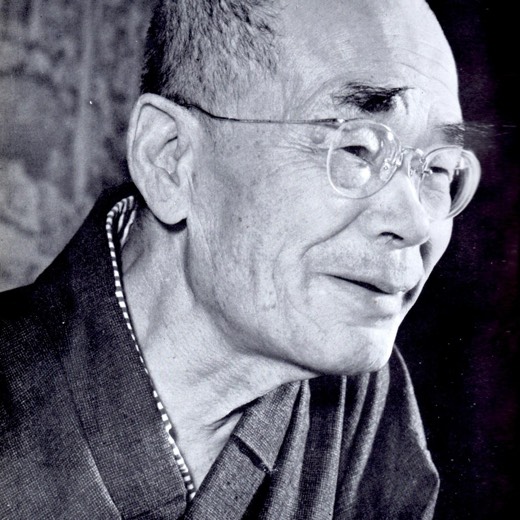
He was also, beneath the gentleness, a fierce critic of the spiritual marketplace of his own day. The Rinzai establishment was deep in formalised koan practice that Bankei thought had become an industry of acquired enlightenment-experiences. They are buying brocaded robes for a wooden Buddha, he complained. He died at seventy-one, leaving behind a circle of students but founding no formal school. His teaching went largely underground in Japan for two centuries before D. T. Suzuki and others brought him back into the contemporary Zen conversation in the twentieth century.
He left no written work in his own hand. The English-language record is gathered in Bankei Zen and The Unborn, both translated by Norman Waddell from the surviving Japanese transcripts of his talks; both are in copyright and we cannot host them here.
Where to read more
- Bankei Zen (Norman Waddell, North Point Press, 1984): the standard collection of his recorded talks in English, gathered from several seventeenth-century Japanese transcripts.
- The Unborn: The Life and Teaching of Zen Master Bankei (Norman Waddell, North Point Press, 2000): the more complete edition, with Waddell’s biographical introduction.