Siddhartha Gautama was born around 563 BCE to a noble family of the Shakya clan in what is now southern Nepal. The traditional account is that he was raised in protected luxury, encountered for the first time the realities of old age, sickness, and death only as a young adult, and at twenty-nine left his palace, his wife, and his newborn son to seek a way through the suffering he had glimpsed. For six years he studied with the great teachers of the Indian forest tradition and pursued severe ascetic practice, taking his body to the edge of starvation and finding that this brought him no closer to the answer.
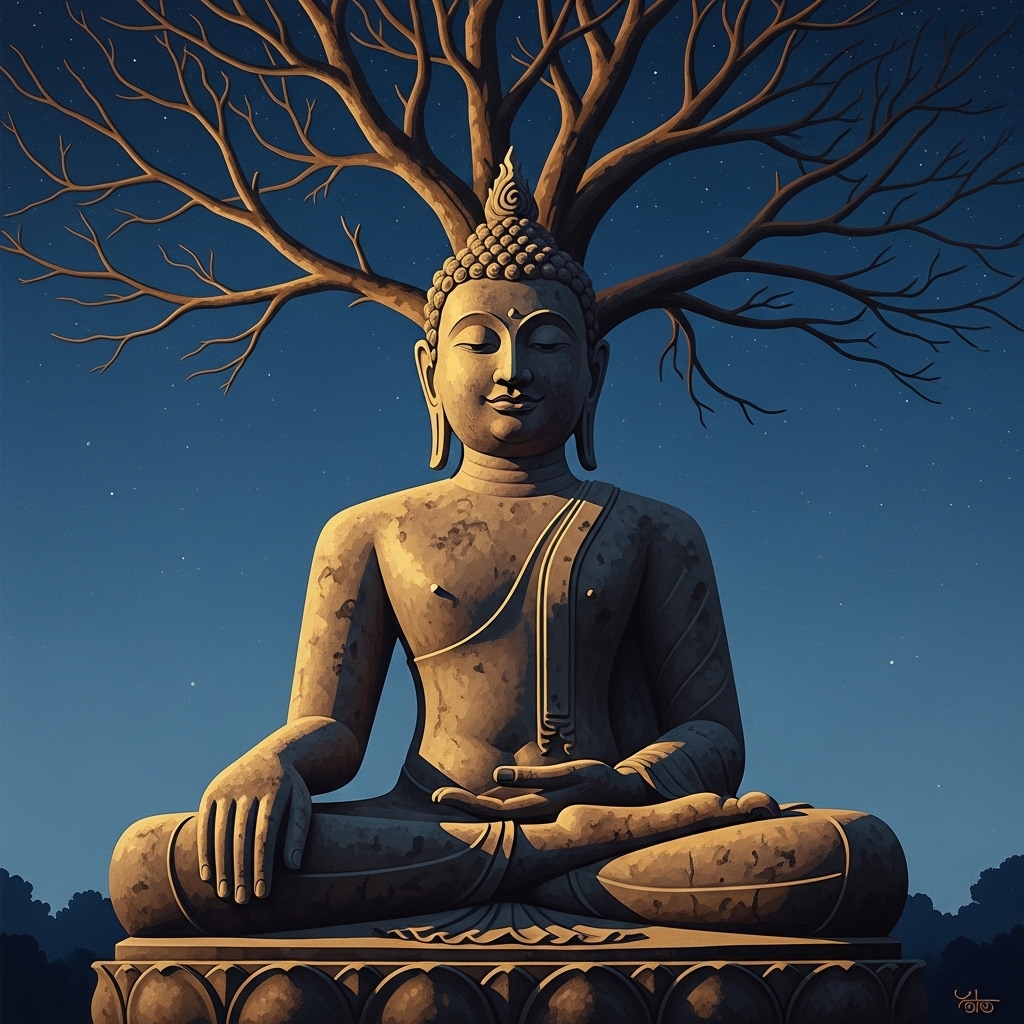
He sat down under a fig tree at Bodh Gaya and resolved not to rise until the question was resolved. The tradition dates everything from that night. By dawn he had seen the dependent and selfless nature of all phenomena: that nothing arises by itself, everything depends on conditions, and the apparent solid self at the centre of one’s experience is itself a conditioned arising rather than a substantial fact.
For the next forty-five years he travelled the dust roads of north India and taught what he had seen. The teaching is preserved in the Pali canon as the four ennobling truths (the fact of suffering, its origin, its cessation, and the path leading to its cessation), the eightfold path, the three marks of existence (impermanence, unsatisfactoriness, and non-self), and the long chain of dependent origination that maps the way the apparent self is constructed and falls apart. The verses of The Dhammapada gather the pith of his sayings.
What is most distinctive in the Buddha’s teaching, and what made it strange in its own time and remains strange in ours, is the refusal of any positive metaphysical foundation. He declined to answer the speculative questions, declined to assert the existence of an eternal self, declined even to assert its non-existence in any final way. The teaching is offered as a raft, not a destination, and the raft is to be set down once it has carried the practitioner across. Be a lamp unto yourselves, he is recorded as saying near the end of his life. Work out your liberation with diligence.
He died at eighty in a small grove near Kushinagar, surrounded by his disciples, in what the tradition calls his parinirvana, his complete release. His last words, recorded in the Mahaparinibbana Sutta, were a final pointing: all conditioned things are impermanent; strive on with diligence.
The teaching
The briefest complete statement of it may be the instruction to Bahiya, a wandering ascetic who stopped the Buddha on his alms round and asked to be taught on the spot (Udana 1.10). The Buddha told him: in the seen, let there be only the seen; in the heard, only the heard; in the sensed, only the sensed; in the cognized, only the cognized. When experience is met this way, no one stands behind it as its owner. You are not “with that,” not “in that,” neither here nor there nor in between. Just this, he said, is the end of suffering. Bahiya understood as he listened and was freed on the spot.
Where to start
- The Dhammapada: the essential collection of his sayings, hosted here in full.
- The Heart Sutra: the later Mahayana distillation of the emptiness teaching, a page long, hosted here.
- The Diamond Sutra: the Mahayana dialogue on non-clinging that grew from his teaching on non-self, hosted here.
- The Bahiya Sutta: the full text of the instruction above, in Thanissaro Bhikkhu’s translation at Access to Insight.