A theme through the library

Self-Inquiry

The investigation of the I-thought back to its source. Common to Ramana, Nisargadatta, Robert Adams, and the Direct Path.

All that is required to realize the Self is to be still.

Ramana Maharshi

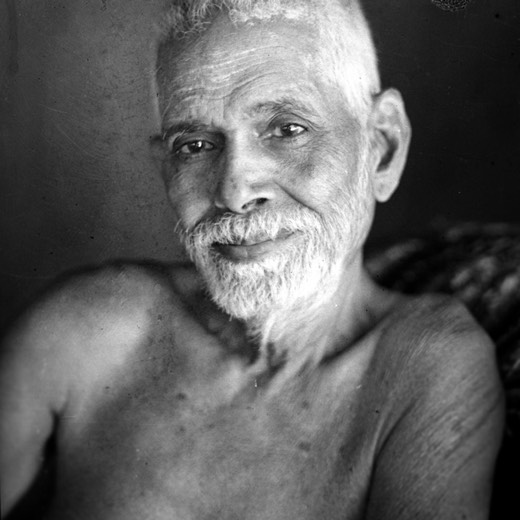
Self-inquiry is the path of investigating the I-thought back to its source. The investigator looks for the one who looks. Ramana Maharshi taught it in its purest form as the question Who am I?, returned to again and again whenever any thought, feeling, or sensation arises. Not as an intellectual puzzle but as a practical investigation. The thought arises, and the question follows: to whom does this thought arise? When the answer comes, to me, the next question is who is this me?. The I-thought, traced back, dissolves into the awareness from which it arose.

Nisargadatta gave the practice a slightly different shape. The question becomes the simple I am, held without addition. Stay with the bare sense of being, before any qualifier (I am John, I am tired, I am happy) attaches to it. The naked I-am, attended to with patience over months and years, eventually reveals what was always present underneath.

The Direct Path teachers (Atmananda Krishna Menon, Jean Klein, Francis Lucille, Greg Goode) work the same investigation through structured contemplative experiments on the body, the senses, and the mind. Robert Adams brought it to small Los Angeles satsangs in the 1990s in a particularly gentle voice. John Wheeler carries it forward today.

What unites the lineage is the recognition that no doctrine, no belief, and no future event delivers the answer. What is sought is what is already and obviously the case. The work is to notice.

Texts that work this thread

The library

Christian Mysticism

Confessions

The first sustained spiritual autobiography in Western literature. Augustine writes the Confessions as a long prayer addressed directly to God, tracing the movement of his soul from dispersion in worldly desire to the recognition that God is interior to the soul itself.

Gnostic Christianity

The Gospel of Thomas

A first or second-century collection of 114 sayings of Jesus, presented as the secret words spoken to Didymos Judas Thomas. Recovered intact from the desert at Nag Hammadi in 1945, the gospel preserves a stream of Jesus tradition that runs alongside the canonical synoptics and pushes much closer to the wisdom-saying form than the narrative form that dominates the New Testament.

Buddhist Nonduality

The Heart Sutra

The shortest and most concentrated of the Mahayana wisdom sutras. In roughly two hundred and sixty Chinese characters the Heart Sutra states the central recognition of the Prajnaparamita literature, that form is emptiness and emptiness form, and that this recognition itself is the path through suffering to liberation.

Buddhist Nonduality

The Diamond Sutra

A dialogue between the Buddha and the elder disciple Subhuti on the nature of perception, identity, and the bodhisattva path. The Diamond Sutra is among the oldest dated printed books in human history (a 868 CE Chinese woodblock copy survives in the British Library) and remains one of the central texts of Chan and Zen.

Christian Mysticism

Sermons and Tracts

The German sermons of Meister Eckhart push Christian apophatic theology into formulations of strikingly nondual recognition. Preached to lay audiences and Beguine communities of the Rhineland in the early fourteenth century, they remain the most radical sustained body of mystical writing in Western Christianity.

Buddhist Nonduality

The Lankavatara Sutra

A foundational Yogacara sutra cast as the Buddha's teaching to the king of Lanka, addressing the nondual nature of mind, the eight consciousnesses, and the doctrine of mind-only. Especially important to the early Chan tradition, which knew itself for a time as the Lankavatara school.

Gnostic Christianity

The Corpus Hermeticum

Thirteen late-antique philosophical dialogues attributed to the legendary Hermes Trismegistus, the Greek-speaking Egyptian sage. Composed in Hellenistic Egypt across the first three centuries CE, the Corpus blends Greek philosophy with Egyptian theology and what would later be called Gnostic insight.

Advaita Vedanta

Brahma Sutras

The third foundational text of Vedanta, after the Upanishads and the Bhagavad Gita. Badarayana's terse aphorisms, perhaps four words each, condense the Upanishadic teaching into a system.

Advaita Vedanta

Vivekachudamani

Shankara's most famous prakarana grantha. A systematic teaching on viveka — the discrimination between the real and the apparent — set as a dialogue between teacher and student.

Advaita Vedanta

Atma Bodha

Shankara's compact exposition of nondual recognition. Sixty-eight verses summarising the entire path of self-knowledge.

Advaita Vedanta

Aparokshanubhuti

A short Shankara work focused on direct rather than mediated knowledge. Where other Vedantic texts approach realisation through inference and analysis, Aparokshanubhuti points to the immediate perception of the Self that is the actual condition for any knowing whatsoever.

Advaita Vedanta

Yoga Vasistha

A vast work of stories, dialogues, and direct teaching on the nature of consciousness and the dreamlike quality of the apparent world. Vasistha instructs the young prince Rama on the path of self-knowledge, weaving philosophy and parable into one of the longest spiritual texts in any tradition.

Advaita Vedanta

Ashtavakra Gita

The Ashtavakra Gita is among the most uncompromising texts in the Advaita tradition. King Janaka asks how liberation is attained, and the sage Ashtavakra answers with verses that leave no foothold for the seeker to stand on.

Advaita Vedanta

Avadhuta Gita

The song of the avadhuta, the one beyond all categories. Pure recognition without instruction.

Advaita Vedanta

Tripura Rahasya

One of the texts Ramana Maharshi recommended most often. The story of Hemachuda's awakening, told as a sustained dialogue between Parashurama and Dattatreya, mapping the territory between Tantric Shaivism and Advaita Vedanta.

Advaita Vedanta

Yoga Sutras of Patanjali

The classical text on yoga as the systematic stilling of the modifications of mind. Patanjali's compact aphorisms map the entire territory between ordinary distracted awareness and the recognition of the witness.

On video

Talks on this thread

All Problems Belong to the I See through it. John Wheeler.
From self to Self Nisargadatta Maharaj
Because You Exist, Others Exist Robert Adams
Siddharameshwar Maharaj A short reflection on the Sadguru of the Inchagiri Sampradaya
The Perfect Spiritual Guide to Enlightenment Ashtavakra Gita