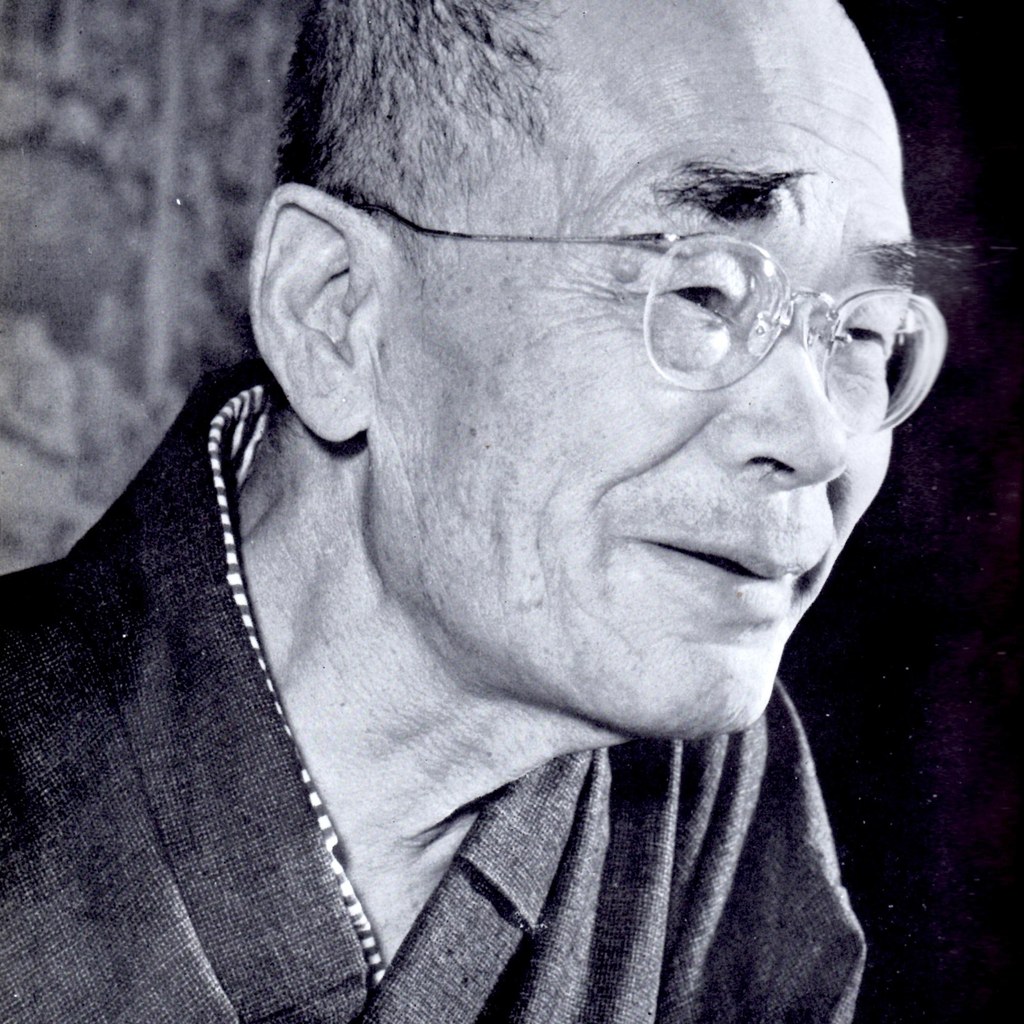
Daisetz Teitarō Suzuki was born in 1870 in Kanazawa, on the western coast of Japan, into a samurai family that had lost its place in the post-Meiji upheaval. He studied at Tokyo Imperial University, sat under the Rinzai Zen master Shaku Sōen at Engaku-ji in Kamakura through his twenties, and in 1897 sailed for the United States to work as a translator at the Open Court Publishing Company in Illinois. He stayed eleven years. He returned to Japan, married, took a chair at Otani University in Kyoto, and spent the next sixty years writing.
His project was singular and historically consequential. Through more than thirty English-language books published between 1900 and his death in 1966, he made the central texts and the central recognitions of Mahayana Buddhism, especially Zen, available in English for the first time. The three-volume Essays in Zen Buddhism (1927–1934), the Manual of Zen Buddhism (1935), the Studies in the Lankavatara Sutra (1930), the translations of the Lankavatara and the Awakening of Faith, the late lectures collected in Mysticism: Christian and Buddhist (1957), the conversations with Thomas Merton, the dialogues with Erich Fromm and Carl Jung. Together they constitute the bridge over which Zen walked into the Anglophone twentieth century.
What is sometimes forgotten about Suzuki is that he was not primarily a popularizer. He was a careful philological scholar who happened to have lived for thirty years inside the practice he was describing. His core philosophical move, repeated across the books, is to point at the Buddhist recognition through the language of the apophatic Christian mystics. He read Eckhart with deep recognition, taught at Columbia in his eighties to a generation of students that included John Cage, Allen Ginsberg, and Robert Aitken, and corresponded warmly with Thomas Merton in the years before his death. The Zen he transmitted is unmistakably Japanese in its method and its imagery, but the recognition he was pointing at he understood to be universal.
He was a quiet and warm man by every report, with an unforced humour and an extraordinary capacity for sustained work. He wrote his last book at ninety-five and died the following year. The Western nondual scene that took shape in the second half of the twentieth century (Zen practice centres in California and New York, the Mahayana literature available in paperback, the Buddhist-Christian conversation that Bede Griffiths and Thomas Merton carried forward) was built largely on groundwork Suzuki laid.
The teaching
Suzuki’s central term is satori, the sudden seeing into one’s own nature that he placed at the heart of Zen. He insisted that satori is a fact of experience, and that Zen without it is an empty form. The koan, in his account, is the instrument that brings it about: a question the intellect cannot resolve, held until discursive thinking exhausts itself and the mind opens onto what was there before thought. He was careful to add that satori is a beginning. What follows is the slow work of letting the seeing soak into ordinary life, until drawing water and chopping wood are themselves its expression.
Where to read more
Most of Suzuki’s books remain in print. The most useful starting points:
- An Introduction to Zen Buddhism (1934): short, accessible, with a foreword by Carl Jung. The single most-read Suzuki book in English.
- Manual of Zen Buddhism (1935): anthology of central Zen texts, koans, and rituals in his translation, with brief commentary.
- Essays in Zen Buddhism (3 vols, 1927–1934): the major scholarly statement.
- Mysticism: Christian and Buddhist (1957): late comparative work, written in dialogue with Eckhart.