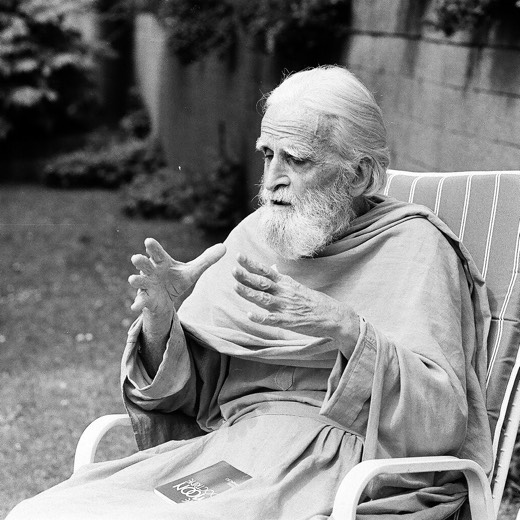
Tauler was Eckhart’s spiritual heir. A Dominican friar based primarily in Strasbourg, he heard Eckhart preach in his youth, absorbed the teaching of the soul’s ground, and spent the next forty years translating it into pastoral German vernacular sermons that could be heard, lived, and practised by ordinary lay Christians.
His genius was integration. Where Eckhart pushed metaphysics to its outer limit and was condemned for it, Tauler kept the same essential teaching but wrapped it in the language of Christian discipleship: humility, suffering, surrender, the work of the cross. The same nondual ground is there. But the form is one a parish priest could deliver without inviting heresy charges.
He preached often to the Beguines and the Dominican women’s houses of the Upper Rhine, to the Friends of God movement, and to the lay communities devastated by the Black Death of 1348-50, the years he became their teacher in plague time. His sermons return again and again to the inner ground, the Seelengrund, and to what he called the gemüt, the deep orientation of the soul prior to thought.
Luther read Tauler closely. Recommending the sermons to a friend in 1516, he wrote that he had found no theology in Latin or German more wholesome or more in harmony with the gospel. The Theologia Germanica, an anonymous Rhineland tract closely associated with Tauler’s circle, became the first book Luther personally edited and published. Through this lineage Tauler shaped the Protestant Reformation as well as the contemplative current.
The teaching
Tauler’s recurring subject is the ground of the soul, the still depth beneath thought, image, and feeling where God is already present. The work of the spiritual life is to turn toward this ground and let everything that is not God sink away from it. He insisted the turning asks nothing exotic. In his sermons the people who exemplify it are a ploughman, a shoemaker, a woman spinning wool. A trade carried out faithfully, he preached, can serve the soul better than a religiosity full of self-chosen practices, because what matters is the orientation of the gemüt, the soul’s deep intent, and that orientation is available in any work. This is the Rhineland ground taught for people with jobs.
He is also a realist about dryness. When prayer goes dark and every felt sweetness disappears, Tauler tells his hearers to stay in the ground and wait, because God works most deeply where the soul can no longer watch itself working. That counsel, given to communities living through plague years, kept his sermons in continuous use for centuries.
Where to start
- Sermons: twenty-five sermons hosted here in Susanna Winkworth’s translation.
- Theologia Germanica: the anonymous tract from Tauler’s circle that Luther edited, hosted here.
- The History and Life of Doctor John Tauler: the full 1857 Winkworth volume, including the medieval life of Tauler, at the Internet Archive.