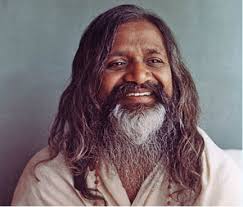
Mahesh Prasad Varma was born in central India around 1918, studied physics at Allahabad University, then in his late twenties went into a thirteen-year discipleship with Swami Brahmananda Saraswati, the Shankaracharya of Jyotir Math in the northern Himalayas, the lineage holder of one of the four monastic seats Adi Shankara is said to have founded in the eighth century. After his teacher’s death in 1953, Mahesh spent two years in silence in Uttarkashi, then began to teach. He took the title Maharishi, great seer, and became known to the world as Maharishi Mahesh Yogi.
His distinctive contribution was to extract a single technique from the lineage and offer it without religious framing as a tool anyone could use. Transcendental Meditation, taught at standardised seven-step courses by certified teachers, asks the practitioner to sit with eyes closed for twenty minutes twice a day and silently repeat a personally assigned Sanskrit mantra. He claimed, and supported with a wave of physiological studies, that the practice produces a measurable fourth state of consciousness alongside waking, dreaming, and deep sleep, and that with continued practice this state stabilises into what he called cosmic consciousness, the standing recognition of the silent witness behind all activity.
He took the technique to America in 1959 and to England in 1960, and from there to the world. The Beatles came to his Rishikesh ashram in early 1968, an episode that would do as much for the global awareness of Indian contemplative practice as any other single event of the century. Through the 1970s and 1980s the TM organisation grew into a worldwide infrastructure of teaching centres, two universities (Maharishi International University in Iowa, Maharishi European Research University in Switzerland), the more advanced TM-Sidhi programme, and a flow of books, recorded lectures, and translations of classical texts including a celebrated commentary on the first six chapters of the Bhagavad Gita.
He remained controversial. The TM organisation has been criticised for its commercial structure, the cost of initiation, and the more idiosyncratic claims of the Sidhi programme. None of which removes the underlying point: he made silent meditation a respectable, accessible practice for tens of millions of people who would otherwise never have sat down. His influence runs through the modern wellness movement, contemplative research, and the broader Western reception of Indian wisdom.
He died at his Dutch headquarters in Vlodrop in 2008, at the age of ninety. The Maharishi Foundation continues to teach the technique worldwide.
Where to start
- The official TM organisation: find a certified teacher near you, learn about the seven-step course, browse research summaries.
- The David Lynch Foundation: brings TM into schools, veterans’ programmes, and prisons; a good entry point if you want to see the practice in social context.
- Science of Being and Art of Living (1963): Maharishi’s plainest book-length presentation of the underlying philosophy.
- Maharishi Mahesh Yogi on the Bhagavad-Gita: A New Translation and Commentary, Chapters 1-6 (1969): his commentary on the Gita; widely regarded as a substantial contribution to modern Vedantic literature.