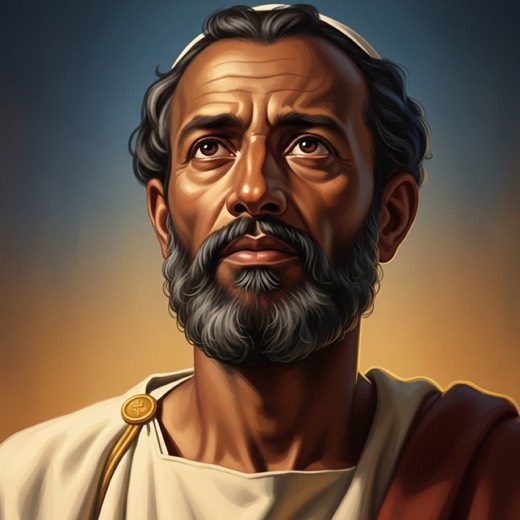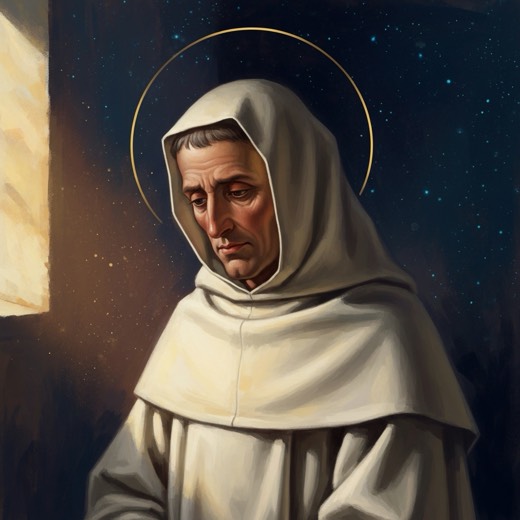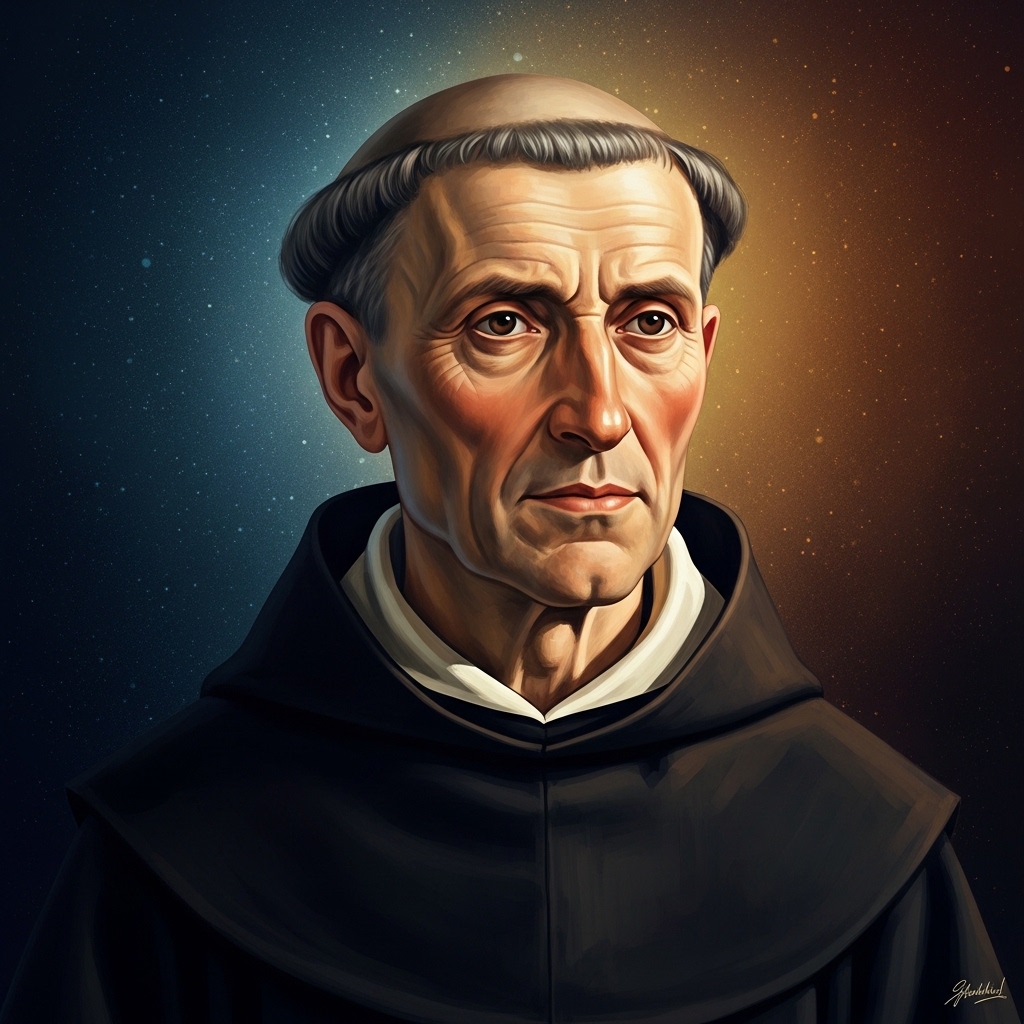
Eckhart was the leading German theologian of his generation, twice holding the Dominican chair at Paris that Aquinas had held before him. He was also the most radical Christian mystic the West has produced. His German vernacular sermons, preached to lay audiences and to the Beguine and Dominican women’s communities of the Rhineland, push apophatic theology into formulations that read like Advaita translated into thirteenth-century German.
His central teaching is the birth of the Word in the ground of the soul. The soul has a deepest centre, what Eckhart calls Seelengrund, the soul’s ground, which is one and the same with the ground of God. In this ground, beyond image, beyond name, beyond the distinctions of the Trinity itself, the eternal Word is born continuously. Liberation is the recognition of what is already and always the case.
He went further. Beyond the named God of religion, beyond even the Trinity, Eckhart speaks of the Gottheit, the Godhead, a groundless ground that is no thing and no person, in which the soul and God are not two. The eye through which I see God is the same eye through which God sees me. The pointing is so close to the Vedanta of Gaudapada and Shankara, written nine centuries earlier on the other side of the world, that comparative scholars have spent a century trying to account for it.
Eckhart was tried for heresy by the Papal court at Avignon in his last years. He died before judgment was passed. The bull of 1329 condemned twenty-eight propositions drawn from his work, and he became a marginal figure for centuries. He was rediscovered in the nineteenth century by German philosophers and in the twentieth by D.T. Suzuki and the new wave of comparative mysticism.
The teaching
Two movements organise the German sermons. The first is Gelassenheit, usually translated releasement or letting-go. For Eckhart the obstacle to God is the self that owns things: its efforts, its devotions, even its images of God. He told his hearers to release these the way one sets down any possession, and in his sermon on poverty of spirit he followed the logic to its end. The truly poor person, he preached, wants nothing, knows nothing, and has nothing, including a God held as an object. A person who still has a God they can point to has not yet come to the ground.
The second movement is the birth. In the Christmas-cycle sermons Eckhart teaches that the eternal birth of the Word, which doctrine locates in the Trinity and history locates in Bethlehem, happens now, continuously, in the ground of the released soul. The birth requires nothing added to the soul; it requires the emptiness that Gelassenheit makes, the way a cleared room receives light. This is why his practical counsel stays so spare. There is no technique to acquire, only an ownership to set down.
Where to start
- Sermons and Tracts: hosted here in the C. de B. Evans translation.
- Theologia Germanica: the anonymous fourteenth-century tract that carried the teaching of his circle forward, hosted here.
- Meister Eckhart, Volume 1: the complete Evans volume of 1924, scanned at the Internet Archive.